

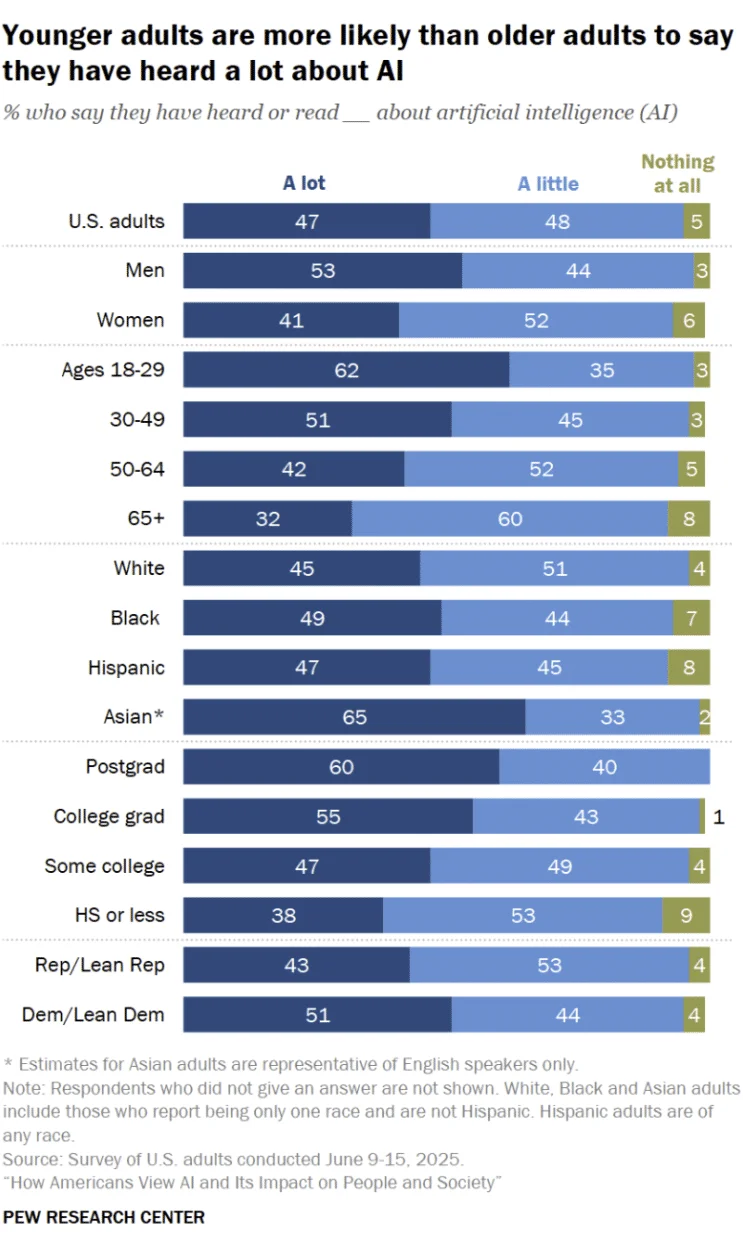
While researching the AI gender gap (opens in a new tab), I discovered another study that gave me pause. According to a 2025 Pew Research Study (opens in a new tab), a full 55% of college graduates and 60% of post-graduates say they’re familiar with current artificial intelligence trends. By contrast, only 38% of those with a high school education say they’ve stayed up-to-date on the latest AI news.
The Pew Research Center looked at the education, gender, race, income, and even political affiliation of participants and ultimately found that U.S. respondents with the highest levels of wealth and education were most aware of AI, how it worked, and the ways it factored into their daily lives. The gap was so large that I couldn’t help but wonder if AI would either contribute to a widening economic gap or exacerbate the one that already exists.
In attempting to answer such questions, nuance is indispensable. After all, there is still the urge in some spaces to jump from one extreme conclusion to another with regards to AI.
To address these questions, I sought out the perspectives of various professionals whose own experiences and points of view in some ways echoed the Pew Research Center’s findings. I also learned that, according to at least one Nobel Prize-winning economist, AI may not have as extreme an impact on industries as some would assume, and that there is a strong potential for positive economic opportunities.
Limitation vs. opportunity: Perception is key
I wanted to hear some professional feedback about AI adoption and what it looks like when people go all in on the technology versus those who hesitate.
Anusha Kovi, a Business Intelligence Engineer at Amazon, found that “people who get the most out of AI tend to treat it like a conversation rather than a vending machine. [It] just fits naturally into how they operate.” She also adds, “They’re not looking for a perfect answer on the first try. They also tend to already be the type who reads a lot, asks a lot of questions, and is comfortable not knowing something yet.”

In terms of people most likely to hesitate or struggle when it comes to getting a handle on AI, senior public relations associate Pilar Lewis shared, “Because they haven’t taken the time to explore it, they might lack the information that would help them understand its capabilities and boundaries. This disconnect is what creates hesitation.”
We can already infer, at least from Pew Research’s findings, that a lack of opportunity to test can lead to that disconnect and subsequent hesitation. That aside, continued exposure, at least in Lewis’s experience, breeds confidence. Said Lewis, “People who use AI tend to take the time to actually learn the tool, its limitations, and how to create a balanced workflow when engaging with it.”
Looking at the broader picture, it’s possible that as more people get familiar with AI, there is a greater potential for many to take full advantage of the technology to start lucrative businesses or make their work lives easier. I was still curious to see if economists already had any useful outlook regarding AI and any potential widening wealth gaps. The outcome? Not as straightforward as I had hoped.
Nobel Prize winner’s lukewarm forecast vs. K-shaped predictions
Daron Acemoglu, 2024 Nobel laureate in economic sciences and MIT institute professor, is probably one of the most trusted authorities in matters of economics in the world. As such, when he speaks about the likely impact of AI on the U.S. economy in the coming decade, one is inclined to listen.
When he published his 2024 paper “The Simple Macroeconomics of AI”, Acemoglu drew a rather lukewarm, if not underwhelming, conclusion: At best AI would boost the American GDP by about 1% and that roughly 5% of tasks would be performed profitably using AI.

He writes that in the coming decade, AI will have a “nontrivial, but modest effect.” Overall, Acemoglu isn’t convinced of either predicted extreme, determining that AI’s lasting impact will be “much less than both the revolutionary changes some are predicting and the less hyperbolic but still substantial improvements forecast by [others].”
Two years on from Acemoglu’s very conservative outlook, other economists have a different perspective. That not only are we moving toward a so-called K-shaped economy, but that AI could potentially contribute negatively to wealth inequality. At least, that was the warning Oxford Economics CEO Innes McFee shared during the company’s Global Economic Outlook conference in January 2026. As Fortune reports, McFee acknowledged that AI had increased the wealth of American households by 7%, with the added caveat that much of the increase was exclusively enjoyed by high income earners.
While not a direct challenge to Acemoglu’s prediction, McFee’s assertion suggests much has changed within the last couple of years, not just in terms of economic outlook, but also with just how much perceived socio-economic impact AI may continue to have for the foreseeable future. That said, we are still far enough away from the 2030s that either economist has the potential to be mostly correct.
By that time, we could be living in a very different world, thanks at least in part to AI. Just consider how much different things are in 2026 than they were in 2020. Still, one would hope for something closer to certainty when trying to determine whether or not AI is at the heart of a widening economic or wealth gap or if it has potential truly to be what closes it. Luckily, a later conversation would lead to a crucial epiphany on the matter.
AI and wealth inequality: A COO’s perspective
Sometimes, the answers to your questions don’t always come from the direction that you would expect. I reached out to multiple professionals, read the back and forth narratives of some of the top economic minds in the world, and in the end, the closest I came to a definite answer was through an online conversation with Daniela Gorza, the Co-Founder and COO of Maigent, Inc. As an AI expert who’s co-chaired the MIT AI Conference since 2024 and a co-founder of Women Who AI, Gorza offered the perspective of someone who understood both sides of the issue.
“The people adopting AI fastest are the ones who already have advantages. They have time to experiment, resources to pay for tools, and jobs that give them permission to try new things.”

To Gorza, the gap didn’t start with AI, it was already there. Regardless of the circumstances, Gorza did not let these concerns stop her from leaning into AI’s problem-solving capabilities. “I realized I was spending maybe 10-20% of my time on actual strategic work and the rest was just coordination chaos.”
Gorza likewise understood the potential for AI to add to both her and potential customers’ capabilities to get work done, to streamline projects, and to do so in a way that keeps humans involved beyond merely staying “in the loop.” She said her goals are oriented “toward making AI an extension of human intelligence rather than a replacement.” She continues, “AI has huge potential to bridge gaps. Imagine someone without access to expensive education getting personalized learning, or someone without a network getting AI-powered introductions.”
Gorza’s observation reveals a simple truth: the same way advances in technology let wealthy early adopters race ahead, it often also allows lower-income late adopters to bridge the wealth gap by creating unique opportunities. Millions of small and medium businesses are able to exist almost exclusively because of the Internet. It’s just as possible that many more can and will exist because of AI technology.
Calming the narrative
Instead of getting caught up in the conversation surrounding whether or not AI was inevitably going to cause or worsen a wealth gap, there were a few key lessons I took from my research that I hope others would apply going forward:
- Run your race. It can be very easy to get caught up in all or nothing outlooks or extreme takes as to whether or not AI is going to make everyone very rich or very poor. Rather than look for one absolute outcome over another, your best bet is to focus on what you’re willing to put into the technology and what value you’re specifically looking to extract from it.
- Learn and apply what you can today, rather than hold off and wait for tomorrow’s forecast. The dueling opinions of top economists over a period of a couple of years should tell you just how fast outlooks change, and just how much influence AI now has. And while it may be that we are currently in a k-shaped economy, that doesn’t mean that you are not allowed to make the most of what the technology is providing for you and your particular business aspirations.
- Timing is important, and you might miss out waiting for an outcome that isn’t even guaranteed. We are lucky enough to exist at a time when technologies like AI continue to level the economic playing field, and where people from all walks of life can utilize it to make their personal and professional lives better while improving their financial outlook.
Lastly, when it comes to the use and advancement of AI technology, every single person has the opportunity to contribute positively towards closing the wealth gap by creating opportunities not only for themselves, but for those around them. Rather than be paralyzed by fear or misinformation, those who move with purpose and with understanding will have a positive influence on the future and on the global economy.